Best Floating Dog Toys for Water Play That Survive Chewers
- The Best Floating Dog Toys, at a Glance
- What Makes a Floating Toy Actually Work
- Best All-Around: A Zogoflex Floating Toy (West Paw Hurley)
- Best for Long Retrieves: A Foam-Core Throwing Bumper
- Best Ball for Swimmers: A Buoyant Thermoplastic Ball
- Best Rope-Assisted Thrower: Kong Aqua and Similar Float-With-Rope Designs
- Best Floating Disc: A Soft, Flexible Flyer
- Comparison Table
- What to Skip for Water Play
- Water Safety Rules That Actually Matter
- Bottom Line
The Best Floating Dog Toys, at a Glance
The best floating dog toys for hard-playing water dogs are solid or foam-core designs that ride high in the water, come in high-visibility colors, and use durable, non-absorbent materials — not fabric or tennis-ball felt. For most swimmers, a buoyant thermoplastic toy like West Paw's Zogoflex line or a foam-core bumper from Chuckit!'s water-fetch range covers dock, lake, and pool duty. Power chewers need one extra rule: the toy goes back in the gear bag the moment the swim ends.
Here's how our picks shake out:
- Best all-around water fetch toy: a Zogoflex floating toy (West Paw Hurley or similar) — durable, buoyant, dishwasher-safe
- Best for long-distance water retrieves: a foam-core throwing bumper (Chuckit! Amphibious-style)
- Best ball for swimmers: a buoyant thermoplastic ball such as Planet Dog's Orbee-Tuff ball
- Best rope-assisted thrower: Kong Aqua or a comparable float-with-rope design
- Best floating disc: a soft, flexible floating disc (West Paw Zisc or similar)
- Skip for water: tennis balls, plush toys, and most rope toys
The rest of this guide explains why those picks earn their spots, where each one falls short, and how to keep water fetch safe for a dog who treats every toy as a chew test.
What Makes a Floating Toy Actually Work
A pool toy has a different job than a backyard toy, so we score water toys on five criteria:
- Buoyancy that survives a bite. A toy that barely floats when new will sit lower once a chewer compresses it or punctures the surface. We favor solid buoyant materials and closed foam cores over hollow air-filled shells, which sink the moment they're pierced.
- Visibility on the water. Dogs see blues and yellows far better than reds and greens, and you need to spot the toy from shore. Bright two-tone toys — a blue or yellow body with an orange accent, say — are easiest for both ends of the retrieve: the blue or yellow half is the part your dog tracks across the water, and the orange half is the part that pops for you against a lake or a treeline.
- Non-absorbent materials. Felt, plush, and rope soak up lake water and hold it — along with bacteria. Smooth rubber and thermoplastics rinse clean and dry fast.
- Throwability when wet. A soaked toy is slippery. Bumper shapes, ropes, and molded grips let you get real distance without launching the toy straight into the ground.
- Chewer survivability. This is the category's central trade-off. The densest, most chew-resistant rubbers we recommend for power chewers sink, so the toys that reliably float tend to be the softer solids and foam-cored builds. Plan for flotation and chew resistance to pull against each other: the realistic goal is a toy that shrugs off the clamp-and-carry of a retrieve, not one that survives unsupervised gnawing.
That last point is the honest heart of this guide. If your dog's main event is chewing rather than swimming, start with our best indestructible dog toys roundup instead — those picks sacrifice buoyancy for density.
Best All-Around: A Zogoflex Floating Toy (West Paw Hurley)
West Paw's Zogoflex is one of the most durable floating materials we'd point owners to, and the Hurley — a simple bone-ish stick shape — is the shape we'd hand most owners first. Zogoflex is a solid, pliable thermoplastic: it floats reliably, bounces unpredictably enough to keep fetch interesting on land, and rinses or goes through the dishwasher after a swampy lake day. West Paw also backs its Zogoflex toys with a damage guarantee, which matters in a category where every toy eventually loses to a determined jaw.
Why it wins: one toy that handles lake, pool, yard, and light tug duty, in high-visibility colors, from a company that stands behind chewer damage.
Worth knowing: Zogoflex is durable for a floating material, but it's softer than dense chew rubber. A dedicated power chewer left alone with a Hurley will carve chunks off it. Treat it as a supervised fetch toy, and retire it once your dog can raise flaps or remove pieces.
Best for Long Retrieves: A Foam-Core Throwing Bumper
Retriever trainers have used bumpers (also called dummies) for generations for a reason: the cylinder shape throws far, lands visibly, and sits high in the water so a swimming dog can grab it without a face full of lake. Chuckit!'s water-fetch line and similar foam-core bumpers bring that format to pet owners — typically a buoyant foam body with a durable outer shell and bright, dog-visible color blocking.
Why it wins: distance and visibility. If your Lab's idea of fetch is a 40-yard swim, few formats throw as far as a bumper or land as predictably where you meant them to, and the shape encourages a soft, centered carry rather than a chewing grip.
Worth knowing: foam cores are the least chew-tolerant construction in this guide. Bumpers are for the water session only — a dog who settles in on the dock with one will open the shell quickly, and exposed foam is an ingestion risk.
Best Ball for Swimmers: A Buoyant Thermoplastic Ball
Plenty of dogs are ball dogs, full stop — they'll ignore a bumper and swim through chop for a ball. The catch is that many dense rubber balls sink, and tennis balls become waterlogged sponges with felt that wears tooth enamel over time. The answer is a buoyant ball designed to float, such as Planet Dog's Orbee-Tuff ball — a rubber-like thermoplastic that pairs decent durability with reliable flotation.
Why it wins: it keeps the ball obsession alive in the water without the sink-and-dive problem. Buoyant balls also tend to be visible sitting on the surface rather than bobbing under it.
Worth knowing: floating balls give up some toughness compared with the solid, sinking, ultra-dense balls we cover in our best fetch balls for power chewers guide. If your dog carries gently, a floating ball can last seasons; if your dog crushes on every catch, expect it to be a consumable. Size up — a ball that can slip behind the back teeth is a hazard on land and doubly so in the water. Our dog toy size guide covers minimum ball diameters by dog size.
Best Rope-Assisted Thrower: Kong Aqua and Similar Float-With-Rope Designs
Kong's Aqua takes a familiar Kong silhouette, builds it to float, and adds a rope through the middle. The rope solves the wet-toy problem: instead of gripping a slick rubber body, you whip the toy by the rope and get real distance with no launcher. Several other brands make comparable float-plus-rope designs; the format is the point.
Why it wins: best throw-distance-to-effort ratio for a wet toy, and the rope doubles as a grab handle when you're taking the toy back from a dog who'd rather keep it.
Worth knowing: the rope is the weak point. Ropes fray, absorb water, and invite chewing. Inspect it every session, and if your dog is a confirmed rope-shredder, either cut the rope off and use it as a plain float or pick a rope-free design. For dogs who turn every retrieve into a tug match at the shoreline, a purpose-built handle toy from our best tug toys for strong dogs roundup is safer for both of you.
Best Floating Disc: A Soft, Flexible Flyer
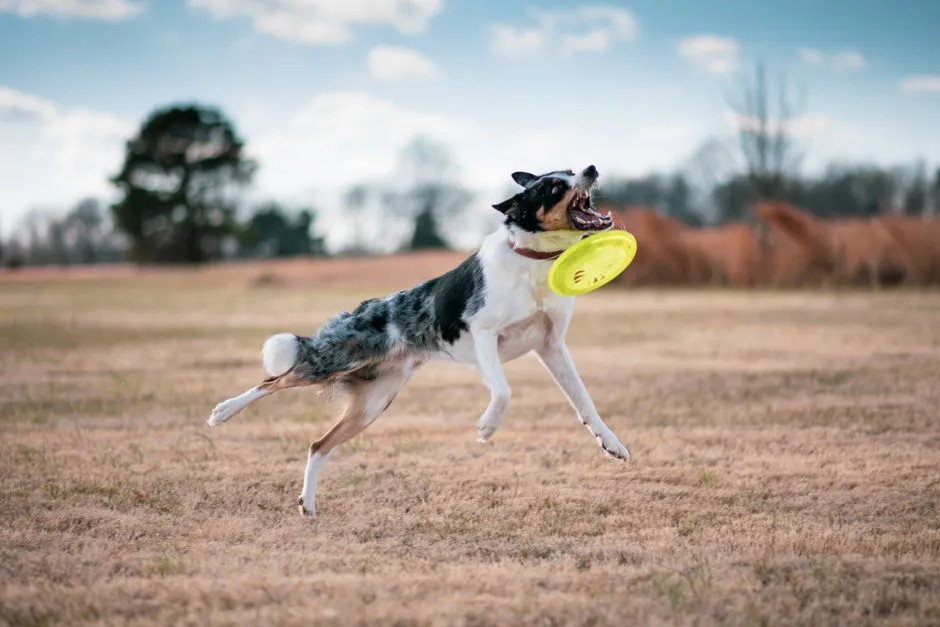
Hard plastic discs crack, and a cracked disc has edges that cut mouths. For water play you want a soft, flexible floating disc — West Paw's Zisc is the well-known example — that glides far, lands flat and visible on the surface, and folds rather than shatters when a big dog catches it mid-air.
Why it wins: discs hang in the air, which lets an athletic dog time a leaping catch off a dock — the single most fun version of water fetch for a high-drive dog.
Worth knowing: flexible discs are the easiest toy in this guide to puncture. The same give that makes them gentler on the mouth than a rigid disc also makes them easy to chew through, and a disc with a torn edge tears further on every catch. This is a throw-only toy; a disc that starts spending time in the "chew position" between throws is on borrowed time.
Comparison Table
| Pick | Best for | Material / construction | Throw distance | Key drawback |
|---|---|---|---|---|
| Zogoflex stick (Hurley-style) | All-around water fetch | Solid pliable thermoplastic, dishwasher-safe | Medium | Softer than dense chew rubber |
| Foam-core bumper | Long swims, retriever drive | Closed foam core under a fabric or coated shell | Long | Foam core fails fast to chewing |
| Buoyant thermoplastic ball | Ball-obsessed swimmers | Molded rubber-like thermoplastic, hollow or foamed | Medium (long with launcher) | Less tough than sinking dense balls |
| Float with rope (Kong Aqua-style) | Max distance, easy grip | Buoyant rubber body plus woven rope | Long | Rope frays and invites chewing |
| Soft floating disc (Zisc-style) | Dock-leaping catchers | Thin flexible thermoplastic, no rigid rim | Long | Punctures and tears at edges |
What to Skip for Water Play
- Tennis balls. They absorb water, get heavy, grow whatever lives in the pond, and the felt is mildly abrasive on teeth with heavy use.
- Plush and fabric toys. One swim turns them into dripping, bacteria-holding sponges that never fully dry.
- Most rope toys. Great on land for tug; in water they waterlog, get heavy, and shed strands as they fray.
- Hollow air-filled floaters. Cheap pool-toy-style floaters sink the first time a tooth goes through the shell.
Water Safety Rules That Actually Matter
A few habits keep water fetch fun instead of a vet visit:
- Supervise every session. Water play means excited, open-mouthed retrieving — the exact scenario where a torn piece of toy gets swallowed.
- Watch water intake. Dogs who bite at splashes or carry toys open-mouthed can swallow a lot of water. Enforce breaks during long fetch sessions, and stop if your dog seems bloated or lethargic.
- Size up. Wet toys are slippery, which makes a marginally sized toy easier to gulp. When in doubt, choose the larger size.
- Rinse and dry. Lake and pool water are both hard on toys and mouths. Rinse toys in fresh water after the session and let them dry fully.
- Retire damaged toys. Any crack, flap, or exposed foam means the toy is done. Floating toys are consumables for strong chewers — budget for it.
Bottom Line
Match the toy to the game: a Zogoflex-style solid floater for everyday water fetch, a bumper for serious distance swimmers, a buoyant ball for ball addicts, and a rope-assisted float when your arm gives out before your dog does. None of them are chew toys — in this category the toys that float well are generally the softer or foam-cored ones, while the densest chew-resistant rubbers sink — so the winning system is simple: durable floaters for the water, genuinely tough toys on land, and a habit of putting the water toys away wet-but-intact at the end of every swim.